shape
carat
color
clarity

Opinions Needed On Diamond Please

WildFlowers

Rough_Rock
Joined
Nov 14, 2006
Messages
12
I am looking at purchasing a diamond with the following:

Weight: 1.01
Color Grade: H
Clarity Grade: SI2
Cut: Excellent

Polish: Excellent
Symmetry: Excellent
Flour: None

Depth: 62%
Table: 56%
Crown: 35%
Pavilion: 40.6%

HCA: .9

The GIA report says: Internal Graining not shown.

I would appreciate any views or opinions on if this diamond will perform well. TIA

 
WildFlowers|1419659740|3808218 said:
I am looking at purchasing a diamond with the following:

Weight: 1.01
Color Grade: H
Clarity Grade: SI2
Cut: Excellent

Polish: Excellent
Symmetry: Excellent
Flour: None

Depth: 62%
Table: 56%
Crown: 35%
Pavilion: 40.6%

HCA: .9

The GIA report says: Internal Graining not shown.

I would appreciate any views or opinions on if this diamond will perform well. TIA

WildFlowers,

A few things to check on this.

The proportions and HCA score indicate this diamond is certainly worth further investigation. If it is important to you that the diamond be 'eye-clean' you should ask the seller have a gemologist verify this. It is rare to find an SI2 that will meet an 'accepted' standard for "eye-clean". If you find the diamond will face up with a real-life look you desire - the next step is to request a light-performance image (IdealScope or ASET) of the diamond. Post that image here on PriceScope and you will get some good feedback regarding whether or not it will 'perform well."

For reference, the B2C definition of 'eye-clean' (similar to the other reputable vendors on PriceScope) is:
We define an eye-clean diamond as no inclusions seen in the face-up orientation at a distance of 25cm, under normal lighting, when viewed by a gemologist with 20/20 vision.
 
Wildflowers,
Si2 is a pretty broad clarity grade that can include alot of different inclusion types and combinations. In addition to determining whether the stone is eye-clean as Diamond Hawk recommended, you need to be aware of any inclusions that might diminish transparency. The comment about internal graining is not as important as the stone plot and characteristics listed beneath it.

If you post the GIA report (or report number) you will get additional input from community members here.
 
There are lots of clean si2 diamonds, let's hope you found one!
 
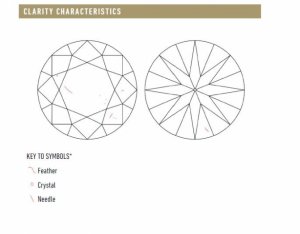
Here is the GIA Inclusion Mapping

diamondcapture.jpg
 
That looks pretty darn clean, can you get an image?
 
I agree, the plot looks pretty favorable. And nothing that would indicate a transparency issue. The grade-setting inclusion is the feather (indicated by its being listed first under the plot). Since it is not on the edge is it very unlikely to present any kind of durability issue. However, because of the location of the feather and the size of it, you may be able to see it with the naked eye. It also depends on how deep it goes which is not possible to tell from the plot. It would likely appear as a white threadlike feature. It may be visible under some conditions and not under others or only from certain angles. You will just need to see it for yourself to make sure it meets your tolerances.
 
Pardon a quick zoom-out for a macro-observation.
AprilBaby|1419712004|3808387 said:
There are lots of clean si2 diamonds, let's hope you found one!
That’s a cool statement to read. I credit the localized PS market. as that comment is not heard much in the trade!

In the context of Pricescope April Baby is correct. Necessity is the mother of invention (or selection in this case): Returns are no-good for e-tailers in expense, time and reputation. The successful Pricescope sellers are choosing SI inventory at a far stricter level than sellers in the mainstream. Even the largest sellers vet SI for their "signature" inventories. It's extra time and attention, but the result is champagne cork after champagne cork flying around PS as buyers report “I got my diamond and it *is* eye-clean! Yay!”

Some behind-curtain stats about SI2: To locate an SI2 crystal foreseen as “eye-clean” we send dozens away. When such a “magic one” falls in our hands with correct characteristics, in balance, in correct places, in proper relief with no opacity from graining or pinpoints our own champagne cork flies… “Found you!” ;) We go forward in our production with it. But beware the lab may see it as SI1, which also reduces SI2 output. To emphasize the point; this razor’s edge is why we don’t offer Cut-To-Order in SI2. Believe it or not it’s easier to guarantee FL clarity than clean-SI2!


So for us it’s dozens, sometimes many dozens, rejected for every “magic” SI2 that can be totally clean, with no performance reduction issues. Of course some we sent away might also wind up I1.-

I think the friendly clarity-context of Pricescope is important here, in the same spirit as cut-context. PS is extremely cool that way: The “I can’t see it until I order it.-” nature of the end-market means eye-clean and cut-performance standards evolve to be notably higher than the average walk-in market. It's needed to ensure that the diamond delights, the sale is a no-brainer and is kept.

Zooming back in...

Texas Leaguer said:
The grade-setting inclusion is the feather (indicated by its being listed first under the plot). Since it is not on the edge is it very unlikely to present any kind of durability issue. However, because of the location of the feather and the size of it, you may be able to see it with the naked eye. It also depends on how deep it goes which is not possible to tell from the plot. It would likely appear as a white threadlike feature. It may be visible under some conditions and not under others or only from certain angles. You will just need to see it for yourself to make sure it meets your tolerances.
Right. When dealing with SI plots several inclusions, spaced about the diamond, are often less visible than one or two grade-setters with more gravity. With that said, a cagey cutter can position a white feather so that it's practically invisible. I'd also check to see if any of the inclusions are "reflectors." Sometimes, with a sparse SI2 plot, a single inclusion may be reflecting around the diamond thus appearing to be many inclusions. Do check the internal graining for opacity too. "Not shown" typically means a non-factor, but SI2 deserves another look. All of these things can be reliably researched by a gemologist with the diamond in-hand.
 
WOW! You guys are spot on for not actually seeing the diamond for yourselves! I had the gemologist take a look at the diamond and it did not come back as eye clean. It had a dark inclusion even though it looked pretty clean. So I am back on the hunt for a nice SI2 stone. Thank you all for your help...you guys really know your diamonds!
 
GET 3 FREE HCA RESULTS JOIN THE FORUM. ASK FOR HELP
Top