shape
carat
color
clarity

Clarity

Medical

Rough_Rock
Joined
Oct 19, 2014
Messages
71
So I was recently looking through the WF ACA selection of diamonds and I came across these two stones:

http://www.agslab.com/pdf_sync_reports/104066134013-PGR.PDF
http://www.agslab.com/pdf_sync_reports/104065628007-PGR.PDF

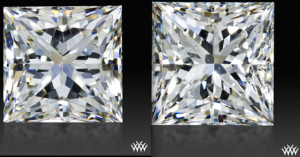
Here are the pictures:

http://www.whiteflash.com/loose-diamonds/princess-cut-loose-diamond-2978548.htm
http://www.whiteflash.com/loose-diamonds/princess-cut-loose-diamond-2960825.htm

If you look at the certificates and pictures, there's a pretty huge difference in the amount of inclusions, but both are ranked by AGS as SI1. Is there a reason that the same grade by the same grading company can vary so significantly? What is the typical amount of variation within a single clarity grade?

 
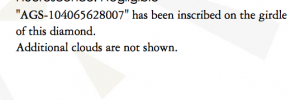
The second report has this note.


Sometimes such "additional clouds" (which can't be marked on the plot) can affect light transmission.

Whether to avoid such diamonds needs to be decided on a case by case basis by an informed person viewing the diamond in person.

Actually now that I compare the pics the cloud note works in the opposite direction and doesn't explain the confusion ... the one with more visible inclusions is the one with the cloud note, shown here on the right.


I'd ask WF to take a look.
It's likely there is something else about the cleaner-looking one that earned it the SI1 grade.

screen_shot_2014-12-22_at_12.png

screen_shot_2014-12-22_at_0.png
 
Wow, you're right. I didn't even notice that. That seems to make the difference in clarity between the two SI1 stones even greater than I originally thought it was, though. I'm pretty surprised that these stones would fall under the same AGS rank.

Thanks for pointing that out! Any idea as to what sort of things could exist that would lower the first stone to an SI1 but not show up on the certificate or images?
 
Medical|1419280545|3805961 said:
Wow, you're right. I didn't even notice that. That seems to make the difference in clarity between the two SI1 stones even greater than I originally thought it was, though. I'm pretty surprised that these stones would fall under the same AGS rank.

Thanks for pointing that out! Any idea as to what sort of things could exist that would lower the first stone to an SI1 but not show up on the certificate or images?

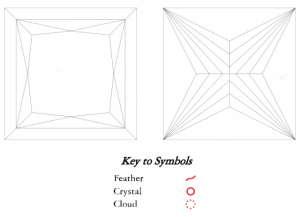
This is from the report for the cleaner-looking diamond:


Under the plot is a list of inclusions.
They are listed in order if seriousness.
A feather is listed first.
Feather is the industry's pretty, non-alarming term for crack.
A billion years ago a bird did not drop a feather onto the forming diamond, like a bug trapped in amber. :lol:

Apparently AGS felt this feather was serious enough to be the grade-setting inclusion and qualifiy it for SI1.

On my monitor I can't make out any other red or green marks on the plot except that one feather at 3:00 on the right plot.
There must be more but often pics are a but overexposed and blows out faint tiny marks.

screen_shot_2014-12-22_at_1.png
 
Medical- in speaking to many thousands of consumers over the years, I have found that clarity grading is one of the most misunderstood aspects of diamond grading.
Keep in mind that the grade is based on the presence of imperfection- as opposed to it's visibility.
Therefore, two correctly graded SI1 diamonds may have show their imperfections in a totally different manner.
Basically- imagine that a small carbon spot exists in a diamond. If it's directly in the center of the stone, over a large facet it might be clearly visible.

Move the very same size spot to a corner and it becomes very difficult to find even with a loupe.
This second hypothetical diamond will be correctly graded SI1, and be virtually identical visually to a Flawless Diamond.

Feathers are not cracks. There's every reason to carefully inspect a diamond for damage- and no reason to eliminate the vast majority of diamonds with feathers for durability reasons.
The only exceptions I can think of would be a stone with a point ( Princess, Pear, Marquise, etc) that has a feather cutting across the stone close to the corner.

Of course, each buyer should buy what they want- but in both cases, feathers, and SI clarity diamonds, it might be easy for a seller to upsell someone by convincing them that one or the other - or both- are inherently "bad".
 
Rockdiamond|1419282872|3805995 said:
Feathers are not cracks.

Medical, feathers are cracks.
Do your own research.
Google around, but consider any financial motivations of the source of what you read.

I don't sell anything.
He sells diamond with 'feathers'.
Who you gonna believe?

Whether or not to reject a diamond with feathers is another matter.
Tons has been written about it her on PS.
Do a search.

Personally, I won't buy one with a feather if others without feathers are available.

I have bought dimaonds with feathers but only because something about the diamond was very rare, such as the cut/shape or the color of a fancy colored diamond.

After white rounds, princess cuts are the most abundant diamond in the marketplace.
I'd let someone else buy those with feathers listed first, especially for SI stones.
 
Hi Medical,
My motivation is educate, so as to allow people to include less costly diamonds in their searches. ( at least in the case of this thread)

I did google it myself and Wikipedia does call feathers "cracks"
So that settles that- as we all know, Wikipedia is NEVER wrong:)

Seriously- when judging diamonds for purchase it's necessary to consider all aspects of clarity, color, and cut.
After having purchased a massive amount of diamonds over the years, I personally would not rule out a diamond based solely on the fact GIA termed one of the clarity characteristics a "feather".

By all means discuss the specifics of the SI1 clarity with the seller- but your best choice may very well be a stone that has the word "feather" on the GIA report. ( I'm not speaking of any stones you have posted, rather in general terms)
 
Medical,

GIA defines the feather as "a separation or break that reaches the surface, and is often white and feathery or shiny in appearance"..

Does that mean a feather should be called a 'crack'? Well, as seen above, that can be debated (and has been) all over PriceScope.

So the larger question is, how does that (or should that) play into your consideration of a diamond?

Some will claim that retailers will down-play the effects of a feather because, as a retailer, they have to sell every diamond - even those with feathers. I would tell you that you can certainly find dealers with questionable motivations (and sub-par product), but many companies exercise strict control over what is offered to the public. If feathers were a significant 'risk' factor in the marketing of diamonds, none of the top companies would carry them: the market-place and educated consumer would simply demand (were there reason) that 'reputable' companies not carry such 'dubious' products.

So, be mindful of the reasons for clarity grades - but also understand that in the process of creating the finished diamond, the diamond has gone through tremendous heat and pressure which far exceeds anything that a diamond will see in normal daily wear. Of course any diamond has the risk if hit at a particular angle to chip or break, so a good insurance policy is always warranted.

I would not disqualify the purchase of a diamond that lists a 'feather' - even as the first notation in the report - if the criteria meets what you are looking for in all other respects.
 
The cleaner looking one has a rather large looking feather on the bottom center of the photograph. It jumped right out at me.
 
Diamond_Hawk|1419318080|3806324 said:
Medical,

GIA defines the feather as "a separation or break that reaches the surface, and is often white and feathery or shiny in appearance"..

Does that mean a feather should be called a 'crack'? Well, as seen above, that can be debated (and has been) all over PriceScope.

So the larger question is, how does that (or should that) play into your consideration of a diamond?

Some will claim that retailers will down-play the effects of a feather because, as a retailer, they have to sell every diamond - even those with feathers. I would tell you that you can certainly find dealers with questionable motivations (and sub-par product), but many companies exercise strict control over what is offered to the public. If feathers were a significant 'risk' factor in the marketing of diamonds, none of the top companies would carry them: the market-place and educated consumer would simply demand (were there reason) that 'reputable' companies not carry such 'dubious' products.

So, be mindful of the reasons for clarity grades - but also understand that in the process of creating the finished diamond, the diamond has gone through tremendous heat and pressure which far exceeds anything that a diamond will see in normal daily wear. Of course any diamond has the risk if hit at a particular angle to chip or break, so a good insurance policy is always warranted.

I would not disqualify the purchase of a diamond that lists a 'feather' - even as the first notation in the report - if the criteria meets what you are looking for in all other respects.

Hi Brian- based on your last statement we're in agreement. There's many cases in my memory where a feather was preferable to another stone of the same clarity grade with a crystal ( for example)- so I won't eliminate a diamond due to that notation on a GA report.

Also a great point about durability- and the stresses a diamond has gone through in the cutting stages before we've even seen it.
Of course even a flawless diamond can break if you hit it just right- but a feather in an of itself is not a durability concern except in very rare cases.


I did have a question about the GIA quote- was that in the course literature?
A colleague has the manual, and it did not mention the part about reaching the surface. Indeed, many feathers I've seen are wholly internal- not coming near the surface.....is it possible that line was changed?
 
Rockdiamond|1419364443|3806637 said:
Hi Brian- based on your last statement we're in agreement. There's many cases in my memory where a feather was preferable to another stone of the same clarity grade with a crystal ( for example)- so I won't eliminate a diamond due to that notation on a GA report.

Also a great point about durability- and the stresses a diamond has gone through in the cutting stages before we've even seen it.
Of course even a flawless diamond can break if you hit it just right- but a feather in an of itself is not a durability concern except in very rare cases.

I did have a question about the GIA quote- was that in the course literature?

A colleague has the manual, and it did not mention the part about reaching the surface. Indeed, many feathers I've seen are wholly internal- not coming near the surface.....is it possible that line was changed?

Hello Rockdiamond,

Indeed, GIA’s 2002 course literature, and the statement made in class by instructors, qualify a feather as always reaching the surface. With that said, I’m told that GIA’s definitions and processes are not always in-sync between what’s printed, what’s instructed and what is happening at their labs.
 
GET 3 FREE HCA RESULTS JOIN THE FORUM. ASK FOR HELP
Top