The Finest Engagement Ring Brands
Choosing an engagement ring is a significant milestone in one’s life journey, and finding the perfect brand can make this experience even more memorable. Some brands stand out among the…

Diamond Fluorescence Described
When grading diamond color the stone will also be checked for fluorescence. About 30% of diamonds have some amount of fluorescence, caused by chemicals in the earth where it formed. Fluorescence can be excited by ultraviolet light or x-rays, and re-emit visible light. In most cases fluorescence is blue, but colors such as yellow, white, orange and red are possible. The strength and color of fluorescence will always be noted on grading reports issued by top-tier laboratories.
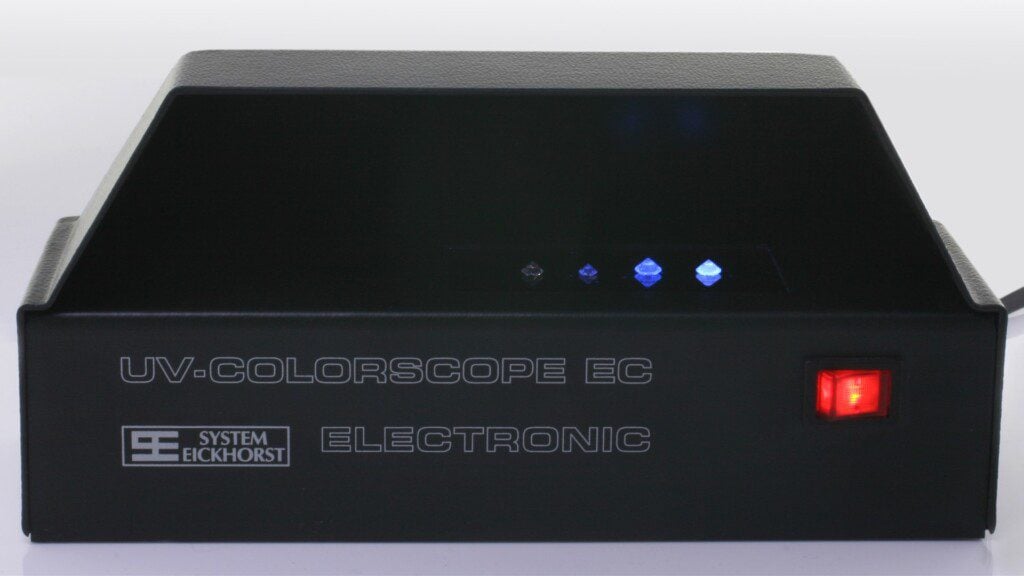
Short-wave and long-wave ultraviolet light are used to test diamonds for fluorescence. When present, the strength and color of fluorescence will be noted on the grading report.
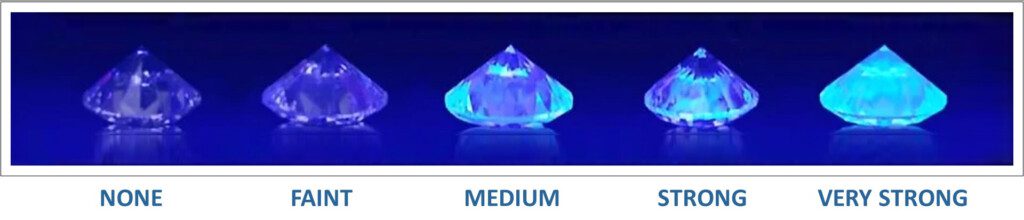
The scale above is used by GIA and most other laboratories. The AGS examines and reports fluorescence differently:
AGS uses the term “negligible” for diamonds with faint or lower fluorescence: First, because the presence of fluorescence at these low levels has negligible impact. Second, because AGS prefers not to state none when stronger levels of UV might make some amount of fluorescence discernible.
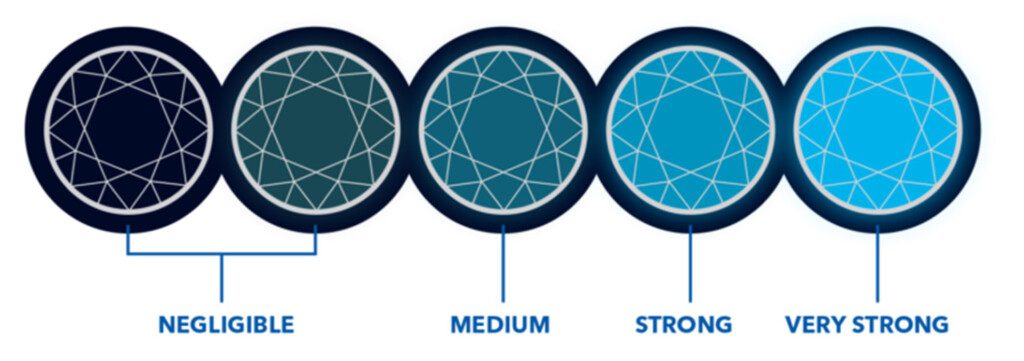
AGS grades fluorescence by observing the diamond in the face-up position, since fluorescence can sometimes be directional, and they wish to grade its influence the same way the diamond will normally be viewed.
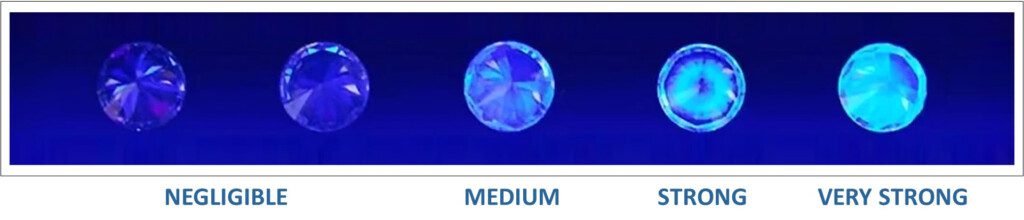
In keeping with the above, GIA qualifies their grade of “none” as follows: “A fluorescence description of ‘none’ represents a range of fluorescence from indiscernible to very faint. Used for identification purposes.”
MAYBE.
It depends on the strength and color of fluorescence in the diamond, the brightness of the environment and how much ultraviolet light is present.
Medium, Strong and Very Strong Blue Fluorescence can usually be seen in a dark room when UV light (such as black lights in a dance club) is present. Medium Blue typically shows itself as a soft blue glow, while Very Strong Blue appears to be lit from within. If the UV source is strong enough, the faint glow of Faint Blue Fluorescence can also be detected.
The influence of Strong and Very Strong Blue Fluorescence can frequently be detected in sunlight, which has a natural ultraviolet component. In general terms, a hint of blue can be seen in casual appearance as well as its underlying optical performance.
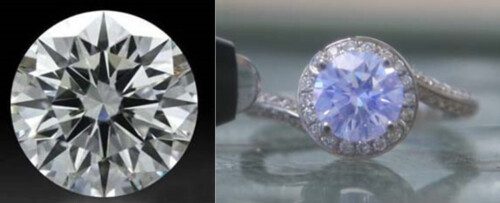
The two photos below show the same 1.34ct diamond. The photo on the left shows what the stone looks like under normal lighting conditions. The photo on the right shows the same stone mounted in a ring, with a strong UV light directed at it, causing the very strong blue fluorescence present to become excited.
YES.
Fluorescent diamonds are traded at a discount, usually in proportion to the strength of fluorescence. D, E and F colored diamonds with fluorescence are discounted more severely than near-colorless and lower diamonds. Whatever the case, you will find that diamonds with medium and higher fluorescence nearly always trade at a discount.
The amount of devaluation is not always inconsistent. For most diamonds, it lands somewhere between 10-25%. For D, E and F colors it can leap to 35%. This chaos makes future value certainty impossible. As a result, some diamond sellers do not make the same guarantees for diamonds with fluorescence that they do for diamonds with negligible or no fluorescence.
Long term value: Our vetted vendors include Whiteflash, Blue Nile and JamesAllen.com – all of whom inspect the diamonds they sell to protect you from any deleterious effects of fluorescence. They have experts ready to listen and help you determine which combo of the 4Cs is perfect for you – and nicely in budget. Call or chat now, and get help today.
Fluorescence is feared and celebrated for different reasons. Long ago, when diamonds largely came from one source in Africa, a series of “overblue” fluorescent diamonds created negative perception about all diamond fluorescence. That reputation persists today, even though such overblue examples are exceedingly rare now. Alternately, those selling diamonds with fluorescence may enthusiastically point to “color improvement,” due to blue fluorescence – which is possible but not always present.
MAYBE.
It is possible for diamonds in the normal color range with blue fluorescence to benefit from face-up color-improvement, but that benefit is limited to low-near-colorless grades and below.
You can always investigate whether a given diamond of I, J, K color or below with strong or very strong blue fluorescence enjoys any face-up color benefit, but keep in mind it has been repeated and exaggerated over time by jewelers trying to sell fluorescent diamonds.
You can read specifics about this and other aspects of fluorescence in this thorough 1997 GIA Study.
Does Fluorescence Impact Performance?
MAYBE.
This is the most important consideration involving diamond fluorescence. While fluorescence does not hinder transparency or optical performance in most cases, any fluorescent diamond should be considered on a case-by-case basis:
“Hazy”, Cloudy”, “Milky” and “Oily” Diamonds
You may hear the terms above to describe diamonds with performance deficits connected to fluorescence. Over time they have become used interchangeably, but each descriptor does have specific meaning.
Haze is usually associated with clarity but may become relevant when coupled with fluorescence. Haze is caused by large clouds of microscopic pinpoints when they become dense enough to interfere with light transmission and reduce transparency. Of course, clarity grading does not assess transparency. The comments “clarity grade based on clouds not shown” and “clouds not shown” (for SI clarities and below) are clues that haziness may exist, but if a diamond has pinpoint clusters only seen at magnification levels higher than 10x they go unmentioned. This happens with some regularity. Diamond trade professionals have a specific nickname for such diamonds, “sleepy.” When a hazy diamond has fluorescence, the pinpoints become more noticeable when the fluorescence reacts to UV. This has caused people to blame haziness on fluorescence (even medium fluorescence), but the fluorescence and haze are independent of each other. Many slightly hazed, or slightly sleepy diamonds are never detected by the average jeweler.
In the style of hazy diamonds (which have persistent pinpoints), a diamond can have isolated but dense concentrations of pinpoints which reduce transparency. Again, these are completely independent of fluorescence, but those clouds are more easily detected when fluorescence is reacting to UV and illuminates them.
In rare blue fluorescent diamonds having Strong or Very Strong fluorescence oversaturated with boron, UV excitement causes a milky, blueish-purple sheen through the diamond which interferes with transparency. These diamonds are nicknamed “overblues.” Most overblues came from the Premier mine decades ago (renamed the Cullinan) when South Africa was the world’s primary source of diamonds. As they arrived at market, dealers began the practice of discounting them steeply and developed a fearful attitude about any diamond with fluorescence, which became exaggerated. That attitude exists to this day among some jewelers and perpetuates the outdated notion that all fluorescence is bad. In response to this, GIA published a study in 1997 which debunked the idea that overblues are common; in fact, they couldn’t even find enough for the study!
Milky Diamond Fluorescence Example
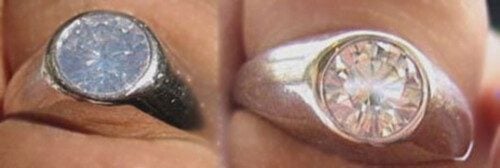
This diamond has extremely strong fluorescence in direct (left) and indirect shaded (right) cloudless mid morning sunlight. In direct sunlight it has a strong milky blue cloudiness that makes the stone very dull (photo on left). But on the right side, even in strong lighting, the stone sparkles beautifully.
This describes the combination of an overblue or nearly overblue diamond with viewing in strong sunlight: when the blueish-purple sheen saturating the diamond in UV daylight mixes with dispersion/fire, it can have the appearance of oil shining on the surface of a puddle. Some diamonds which have a strong sheen show this when viewed in the sun, but you will have to take them outside to see it and, again, they are so rare that most jewelry professionals have never seen one, except in antique and estate jewelry
In overblue cases, these descriptions can occur in the same diamond, but in different lighting conditions.
These elements can be completely independent of fluorescence, but become exaggerated by it.
Other Diamond Fluorescence Colors
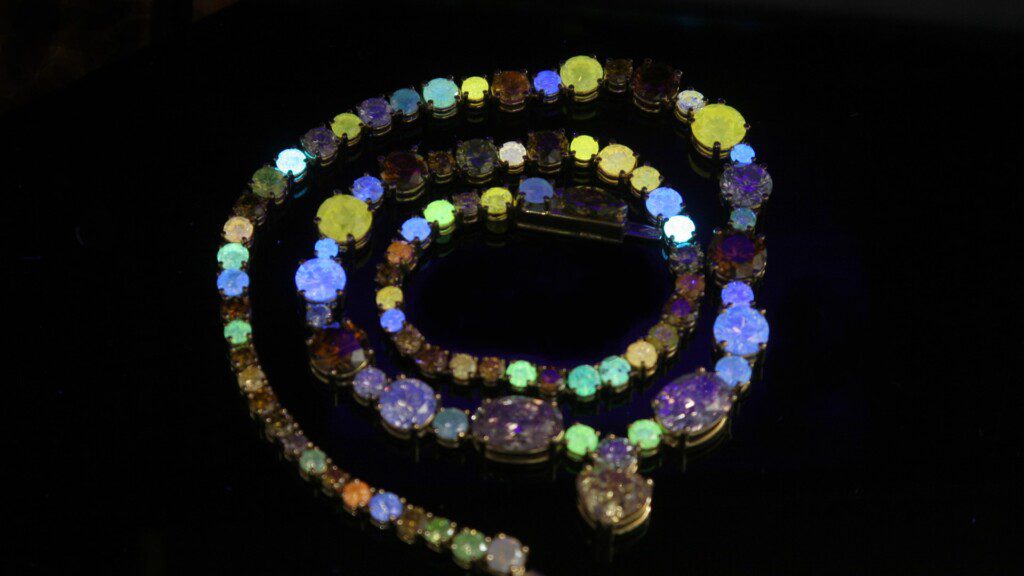
On rare occasions, diamond fluorescence will occur in a color other than blue. Yellow, red, orange, white, and green are known colors of diamond fluorescence. This may be considered desirable if the diamond is a fancy colored diamond of the same hue as the fluorescence since it can make the body color more intense.
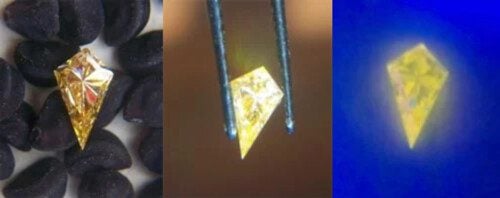
Colorless diamonds with yellow or orange fluorescence will appear to be a lower color when seen in light with a strong UV component. The photos below show how yellow fluorescence enhances the color of a yellow diamond.
Yellow Diamond Fluorescence Example
The photo on the far left shows the yellow diamond in diffuse natural light. The middle and far right photos show the same stone display yellow fluorescence in direct sunlight and under ultraviolet light.
When the UV light is turned off fluorescence ceases instantly, but some rare stones will phosphoresce after exposure.
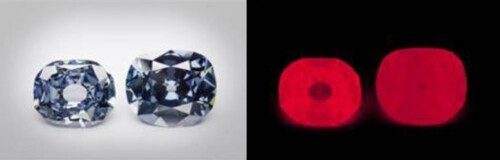
The Wittelsbach-Graff Diamond and The Hope Diamond show intense orange-red phosphorescence. The Hope and The Wittelsbach-Graff both phosphoresce after exposure to shortwave ultraviolet light, but they do not exhibit fluorescence during exposure to shortwave or longwave ultraviolet light. This unique property adds mystery to these incredible and historical diamonds.
Diamond Phosphorescence Example
Here are the 31.06ct Wittelsbach-Graff Diamond and the 45.52ct Hope Diamond in normal lighting (left) and phosphorescing in the dark after exposure to shortwave ultraviolet light.
Get fast answers to any question: Ask our community of unbiased independent helpers.
Ready to find your diamond?
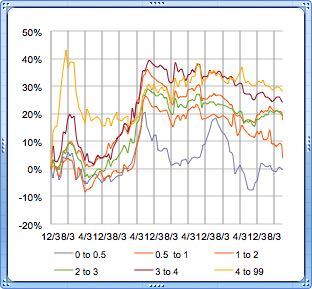
Retail Diamond Prices Chart Updated Monthly.

Choosing an engagement ring is a significant milestone in one’s life journey, and finding the perfect brand can make this experience even more memorable. Some brands stand out among the…

Why should you get your Mom diamond jewelry for Mother’s Day? Diamonds are appreciated for their clarity and brilliance. In much the same way, great mothers offer their children clarity…
If you are looking to pop the question this spring, we have you covered for engagement ring shopping. We’ll add some proposal ideas too to inspire you when you take…