| Re: Discussion of green in an ASET image |
|
|
|
http://www.octonus.ru/oct/mss/index.phtml It does not need millions - it just needs enough to test boundaries
Garry Holloway FGAA DipDT
HCA and Ideal-scope developer http://www.ideal-scope.com and http://www.HollowayDiamonds.com.au |
| Re: Discussion of green in an ASET image |
|
|
|
7 cushions 1 princess 1 pear 1 princess 20 rounds That is enough to develop what exactly? If one accepts simulations and photorealistic video and images that cuts it down from millions to ???? (a fine sampling in each outline shape or cutting style?), Garry your comments often draw attention and promotion to the early foundations of a cut grading system based on ETAS and photorealistic images generated in Diamcalc http://www.octonus.com/oct/projects/strategies.phtml As a proud owner of a license for DC I can appreciate the power of the software, but I also express my frustration on the lack of details and explanations of the simulation parameters. I will respectfully submit that even if one were to give you wide latitude and accept the DC simulations as realistic enough, the scope of your basis set of real cut diamonds for exploring boundaries and the independant peer review of this basis set will have to be greatly enhanced and critically reviewed by independant experts. In addition the precise technical details of ETAS and all aspects of the simulations will have to be carefully written and disclosed to the academic community in a quality peer reviewed article. If not the system is more sophisiticated but may not look much different from other blackboxes which have come before and failed to reach widespread acceptance by trade. |
| Re: Discussion of green in an ASET image |
|
|
|
We broadly agree with your critique CCL. As I mentioned somewhere - HRD were going to do something with us in 2004 / 5 - but they imploded about the time they realised they had big internal problems. So rather than develop a cut grade system to end all cut grade systems (it would have been open after a period of grace to recognise a lab partners contribution) we have decided it is better to 'just do it'. Hence the development of cushion cuts to outperform tolkowsky rounds - that we would like to commercialise. That should show the diamond world that reliance on a 89 year old optimization is pathetic, and hasten them to bet off their bottoms. And then there is the Next Diamond platform, to sell diamonds from multiple plans and reduce the 'pipeline' inneficiencies.
Garry Holloway FGAA DipDT
HCA and Ideal-scope developer http://www.ideal-scope.com and http://www.HollowayDiamonds.com.au |
| Re: Discussion of green in an ASET image |
|
|
|
not a lot of time but I wanted to throw something out here.
When thinking in terms of aset and most real world lighting 1st and second order(single and double reflection) virtual facets are usually enough to define step cuts and rounds but with "crushed ice" 3rd and 4 order reflections take on more importance. In an RB or step cut they are drowned out by the first and second order reflections. One theory I thought of as to why is that one light beam exits at more points in a crushed ice stone where with simply virtual facet models there is 1 major return point and not much more for a small beam of light on most points of the diamond. In looking at a crushed ice stone I noticed that at many points the entire second order virtual facet would not light up but the edges would acting in a more 3d manner than an RB virtual facet of the same size. Thoughts? Last edited by Karl_K on October 17th, 2010, 10:23 pm, edited 1 time in total.
|
| Re: Discussion of green in an ASET image |
|
|
|
Got the first part Did not the red bit Karl? I think you mean the reason it is hard to get a focus on a crushed ice because of the distance to anything to focus on?
Garry Holloway FGAA DipDT
HCA and Ideal-scope developer http://www.ideal-scope.com and http://www.HollowayDiamonds.com.au |
| Re: Discussion of green in an ASET image |
|
|
|
let me try again, the second order virtual facet is being side lite internal to the stone creating another smaller virtual facet set.
Take a mirror look at / look down at it from the top, now only light a small part of the middle of the mirror then light only the very top of the mirror then light the very bottom. That will look totally different than light going in and out directly that is exiting at that point and totally different from each other. The virtual facet is in effect 3d. Garry does that help? |
| Re: Discussion of green in an ASET image |
|
|
|
btw I am just brainstorming here this may not be the answer but it is clear to me that something different does go on with crushed ice diamonds virtual facets.
|
| Re: Discussion of green in an ASET image |
|
|
|
Nope?
Garry Holloway FGAA DipDT
HCA and Ideal-scope developer http://www.ideal-scope.com and http://www.HollowayDiamonds.com.au |
| Re: Discussion of green in an ASET image |
|
|
|
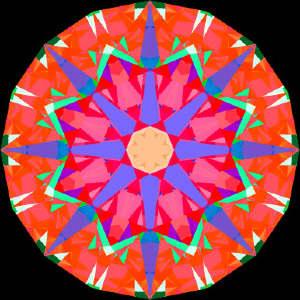
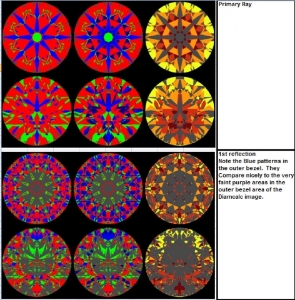
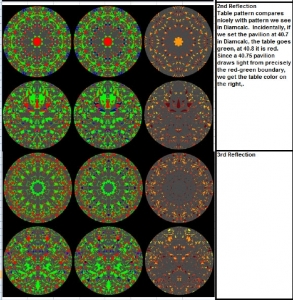
I don't understand your theory. Are you talking about Fresnel splitting or splitting from subsequent bounces? It would appear that Diamcalc properly accounts for Fresnel splitting. With all diamonds the first and second order beams have most of the energy making higher order contributions much less important. To check Garry could you please ask Sergey if the approximations he uses to account for Fresnel splitting breaks down for a higher number of bounces or lower angles, I doubt it. What I see is the number of bounces and the accuracy of the intensity of the ray tracing considered is an issue with longer light paths. I don't understand what the Intensity number is in Diamcalc but raising it dramatically increases rendering time but also seems to improve relative intensity of light accuracy for longer light paths. Shown Below is the Diamcalc ASET30 for a Tolk Round ![]() Shown below are the ASET30 ASET40 and Firemaps for the same stone seperating out the primary and higher order rays. I beleive the addition of the higher order rays properly weighted matches with the DC image. Primary and First Reflection For Tolk Round ![]() Second and Third Order Reflection
|
| Re: Discussion of green in an ASET image |
|
|
|
ccl,
still thinking on the wording for the second part for the first yes I think that the 3rd and 4th maybe even 5th, 6th order reflections have a much stronger influence on what the eye will see in a crushed ice stone than a RB, EC/SE. How DC displays higher order virtual facets and if the VF resolution can be increased is a good question for Serg. 2nd order(double) is the highest available in the direct maps. I am also thinking on what kinds of real world pictures would help. |
| Re: Discussion of green in an ASET image |
|
|
|
I believe you gentleman are hitting upon the crux of my initial question.
In looking at crushed ice stones, smaller areas of green on aset seems to show parts that show a lot of tiny virtual facets IRL- the additional light bounces seen to "disallow" the eye to specifically focus- which in turn causes the "crushed ice" effect. Sometimes, I see areas of green in the aset as a nice area of sparkle, but in this one, the green area near the center oft times looks like a "hole" in the center of the diamond
David
President-Diamonds by Lauren/ Rock Diamond Corp Partnering with Yoram F to produce the only Modern Antique Diamonds on the market cut specifically to show off their yellow color |
| Re: Discussion of green in an ASET image |
|
|
|
RD, can you provide a Sarin scan on this one? I would like to see the angle differences between the pav mains & the pav brillianteered facets. I believe an answer could be there somewhere. |
| Re: Discussion of green in an ASET image |
|
|
|
I just looked at an Israeli suppliers fancy yellows and in every case the most even crushed ice had no blue and more red, evenly dispersed, than green.
Some very creative work on the pavilions with as many as a dozen extra facets.
Garry Holloway FGAA DipDT
HCA and Ideal-scope developer http://www.ideal-scope.com and http://www.HollowayDiamonds.com.au |
| Re: Discussion of green in an ASET image |
|
|
|
kewl any pics? |
| Re: Discussion of green in an ASET image |
|
|
|
No - its a bit rude when the guy has travelled to see as many clients as possible
Garry Holloway FGAA DipDT
HCA and Ideal-scope developer http://www.ideal-scope.com and http://www.HollowayDiamonds.com.au |
| Re: Discussion of green in an ASET image |
|
|
|
Are you surprised? You sound a bit. |
| Re: Discussion of green in an ASET image |
|
|
|
I have never seen such randomly applied extra facets Yoram. They were not for weight retention, as several of the stones were mid 60's - they were fine tuning. They would result in fair or poor symmetry if they were full cert's
Garry Holloway FGAA DipDT
HCA and Ideal-scope developer http://www.ideal-scope.com and http://www.HollowayDiamonds.com.au |
| Re: Discussion of green in an ASET image |
|
|
|
Randomly applied extra facets? Each stone had those applied differently? |
| Re: Discussion of green in an ASET image |
|
|
|
Garry I for one am interested in the design and optimization techniques used for that 4 main cushion. How was it created? How was it optimized? I think you will go a lot further with the promotion of ETAS and DC with a step by step general explanation of technique (with video) than you will just presenting it as a good LP cushion. I am also quite curious other than looking at the cut quality numbers and perhaps ASET30 what other criteria were being measured and optimized in that design? |
| Re: Discussion of green in an ASET image |
|
|
|
|
| Re: Discussion of green in an ASET image |
|
|
|
Yoram, I'll gladly have Sarin run a scan on the stone- but it will likely be a week till we can have it done- ( we're a bit shorthanded this week)
Re: Extra facets on the pavilion : I've noticed that on many occasions. Sometimes there's a facet on one side not mirrored on the other. The stone I posted the aset of above, was cut from the top part of a sawed rough- and it pretty shallow- so there is not a lot of space for the cutter to play with facets to fix things.....
David
President-Diamonds by Lauren/ Rock Diamond Corp Partnering with Yoram F to produce the only Modern Antique Diamonds on the market cut specifically to show off their yellow color |
| Re: Discussion of green in an ASET image |
|
|
|
On the contrary..., the cutter needed lots of play to achieve these results and also know what he is doing, (whats the weight?) By play I mean moving away from the standard brilliant facet design & angles while the focus is on maintaining an even face up color appearance. You dont need to go out of your way to get the file RD. The red highlights the reason why I believe the pav brilianteering is excessively painted resulting in a 'slushy' but sometimes even appearance (can I say slushy? ).
|
| Re: Discussion of green in an ASET image |
|
|
|
|
| Re: Discussion of green in an ASET image |
|
|
|
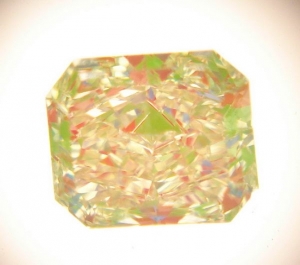
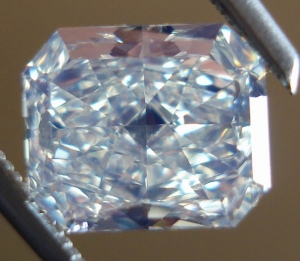
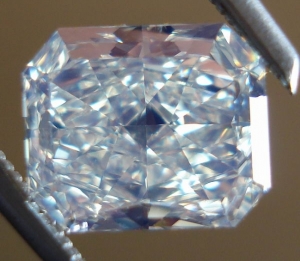
Thank you Yoram- I value your input. The stone finished at 1.18cts. MEASUREMENTS: 6.81 x 6.77 x 3.50 mm TOTAL DEPTH: 60.7% TABLE SIZE: 69% Here's a photo
David
President-Diamonds by Lauren/ Rock Diamond Corp Partnering with Yoram F to produce the only Modern Antique Diamonds on the market cut specifically to show off their yellow color |
| Re: Discussion of green in an ASET image |
|
|
|
Hi RD, my writing was focused at a colored Diamond but in this case the cutters objective was similar and easier. Can you post a reflective pavilion side pic? |
| Re: Discussion of green in an ASET image |
|
|
|
|
| Re: Discussion of green in an ASET image |
|
|
|
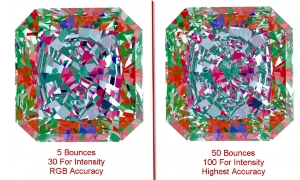
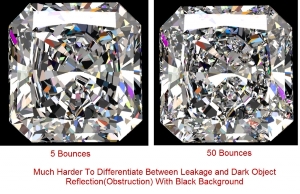
Here I have used Garry's Lightbox lighting scheme with built in Observer and Camera.
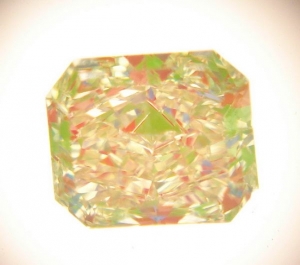
I also took a photograph of a Red Envelope to use as a background so that we could easily separate leakage from Obstruction. Red areas are of leakage, darker areas are reflecting dark objects. As can be seen the virtual facet pattern becomes much more broken up when the number of bounces is increased. Its easier to see the difference between the two in this lighting.
|
| Re: Discussion of green in an ASET image |
|
|
|
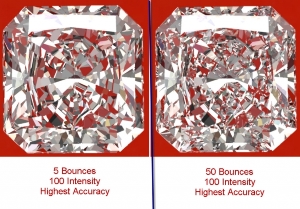
Determining the source of dark regions in a diamond is difficult when the background is dark.
Here is the same ORC radiant from RD this time using the default background of black under the same lightbox lighting as above. In this lighting we cannot determine if the darkness in the diamond is a region of leakage or of reflecting a darker object.
|
| Re: Discussion of green in an ASET image |
|
|
|
Yoram- the stone is an N color- so it's possible the larger, bottom piece was a light yellow ( maybe U-V, W-X for example).
It's super strong blue fluorescence, which makes it look whiter- but it's fairly yellow in person. I believe the cutter ( who is indeed very skilled in such stones) was going for a light yellow I'll get some more shots and post them later ccl- from what I can tell, the simulations are lacking due to the number of bounces. Theoretically, plotting out and simulating a stone with 5 bounces in reality is a lot easier than doing so with something like a crushed ice stone where the number of bounces must be impossible to accurately calculate. Even a small tilt will change the number of bounces significantly. Is it possible that the bounces are what's throwing off the simulation?
David
President-Diamonds by Lauren/ Rock Diamond Corp Partnering with Yoram F to produce the only Modern Antique Diamonds on the market cut specifically to show off their yellow color |