
Dear All,
I recently bought a diamond ring from eBay. The seller described the diamond as an OEC, SI1, K, 4.8-4.9mm in diamter, approx. 0.46 ct.
I'm very pleased with the way the diamond performs. However, I noticed that the diamond doesn't seem to have a culet - not even a tiny one. In fact, the tip of the pavillion seems quite pointy. Neither do I see a culet from the top no matter how closely I look.
I am attaching 3 pictures - 1st is from the seller, 2nd is a photo which I took, and the 3rd is a close crop of the 2nd photo (pardon the little flecks of dust). Picture 1 shows the pointy tip, while pictures 2 and 3 show the facet pattern (quite hard to capture but this is the best I got) and the lack of a culet when viewed from the top.
My question is - is it possible for an OEC not to have a culet? If not, does this mean my diamond is not an OEC but some other cut entirely?
Will appreciate everyone's input! Thanks!


I recently bought a diamond ring from eBay. The seller described the diamond as an OEC, SI1, K, 4.8-4.9mm in diamter, approx. 0.46 ct.
I'm very pleased with the way the diamond performs. However, I noticed that the diamond doesn't seem to have a culet - not even a tiny one. In fact, the tip of the pavillion seems quite pointy. Neither do I see a culet from the top no matter how closely I look.
I am attaching 3 pictures - 1st is from the seller, 2nd is a photo which I took, and the 3rd is a close crop of the 2nd photo (pardon the little flecks of dust). Picture 1 shows the pointy tip, while pictures 2 and 3 show the facet pattern (quite hard to capture but this is the best I got) and the lack of a culet when viewed from the top.
My question is - is it possible for an OEC not to have a culet? If not, does this mean my diamond is not an OEC but some other cut entirely?
Will appreciate everyone's input! Thanks!




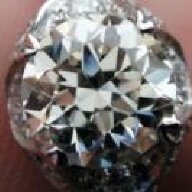
 ), but it's actually a transitional with an open culet.
 But right now, after having worn her for a few days,I think I will leave her the way she is. I'm not a fan of yellow gold but something about this particular diamond in this particular setting just looks...right.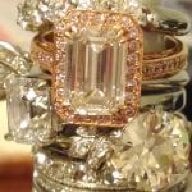



300x240.png)