|
|
|
|
Not sure about GIA vs EGL contest... There is some debate wether these should be graded face-up (i.e. taking into account the impact of the cut on aparent color intensity, as well as the color intensity of the material) or culet-up (taking only the color of the material into account), but I am not sure GIA and EGL differ in this regard. GIA grades these face-up. Both labs are reputable... but finer detail I do not know.
Why origin of color only? Clarity! That's the ususal (90% of cases) answer. Cost... yeah, but not really: they've got some cert and a few dollars more would probably not swamp the total price. Small stones... it really depends. If you have a 0.5cts vivid and VVS, it will have a full cert, believe me. It all boils down to what % of the total price to cost of certification is (10% is about the upper limit, I guess). What is the stone like? Just curious... |
|
|
|
|
In regards to grading fancy color diamonds, it is my understanding that GIA grades fancies face up rather than face down for white diamonds. I'm curious to know what GIA tests and procedures are done to grade the color of origin - specifically for green diamonds (I've read in several places that sometimes the only way GIA will issue a "natural" grade is when the lab has seen/verified the stone in many of its cutting stages, since it can be very hard to distinguish whether the color has come from natural irradiation or from artificial irradiation. Does anyone know if EGL uses the same standards and equipment to grade these types of stones?
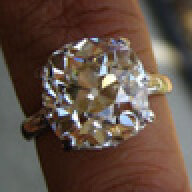
Another reason I ask this is because a stone in question is EGL certified as "natural fancy light bluish green". I have attached a picture next to a D colorless white diamond for contrast. Unfortunately the photo is not the best, but it was taken with natural lighting. It is a very interesting color. Thoughts, commments, etc.? kroshka
|
|
|
|
|
You are right to say that green diamonds pose some problems for identifying color origin, but not all of them are troublesome: other characteristics aside color itself can be used to identify the natural origin of color. For example, one "fancy green", VVS1 took three months at GIA to finaly receive it's "natural" color origin status, but this was an exception. In rare cases the lab would just say that the color origin is "inconclusive".
I would not say that GIA or EGL is less/more trusted with this sort of thing: there are not that many green diamonds around to devise statistics of lab precission. I would imagine that you can obtain a GIA cert for this one if you so wish: the name of the lab is still worth a headache less... regardless. This is more a matter of "why not" than "why". The procedure for grading color (i.e. face up) is the same at both labs, as far as I know. Besides... some dangerous gem, isn't it ?
|
|
|
|
|
Any ideas as to what other characteristics aside from color can be used to identify natural origin of color? My guess is the inclusions or other trace elements that are detected in the stone might give clues as to it being natural? This particular stone does not look like the majority of irradiated goods out there. In fact I don't think I've ever seen any irradiated stone that looks like the color of this one.
I think it is probably a good idea to send it to GIA to get it certified, although I was just curious as to how valid/accurate people or experts think EGL USA is for grading fancy color diamonds. I have started to see a lot of brown and yellow diamonds that are EGL certed - I'm assuming this might be because of the cost and turnaround time. I'm wondering if the leniency on color grade is a factor too? Has anyone ever seen EGL certified pinks or other colors other than yellow and brown or cominations thereof? Anyone ever have a stone both certified by EGL and GIA? How did the reports compare? When buying a fancy colored diamond, I do think GIA is the most reliable and consistent way to go. However, do others think that an EGL cert. would be acceptable/trustworthy for a fancy, at least in terms of origin of color? kroshka |
|
|
|
|
Hi Joker,
I agree that anyone spending any kind of serious money on a fancy color diamond should only get one with a full GIA report (even if it the diamond is only $2000). I think it would be interesting to know how the two labs compare for fancy colors and how consumers and professionals in the business feel about the accuracy and consistency EGL USA has for color of origin and color grading. Also, I would like to understand the motives/choices for why some dealers and sellers of fancies have their stones certed by EGL rather than by GIA (i.e. is it because of turnaround time, cost, leniency in grading, etc). It's just a pattern that I have noticed lately, was intrigued by, and had not found any real answers to. I should also add that I am just a consumer - not a dealer or jeweler, etc. I just want to learn more about these fascinating gems from others like myself or qualified professionals. kroshka |
|
|
|
|
At leats for white diamonds, "leniency" and cost could be the start of an answer. Also - and I could be wrong at this - EGL would certify treated/artificial diamonds but GIA would not issue a report for them. Turnover time... not sure: this is not constant at any lab. I am sure that in the case of some inexpensive brownish batches, cost, time and grading precision are key decission factors, but in the case of a diamond with rare color (such as that one), the reputation of the lab is probably all that counts. And this reads GIA. It is not unusual for a rare stone to carry several certs, be it only because several potential customers required re-certification by their authority of choice. No, the color of your diamond is not what one ususally sees in treated ones, but, high white diamonds rarely get irradiated to obtain this shade. The usual material that gets cooked (browns) do not yield this color. Following this logic, this stone could have been irradiated. Natural green diamonds are a result of iradiation too... as you know. However, the process of natural irradiation is different from the lab's (give or take a few geological eons!) so internal characteristics would be affected differently by artificial as oposed to natural "coloring" irradiation. This is what labs are after. This also explains why a VVS green is all that much more difficult to judge. If your stone is a rare species, you may want to go to a lab who reportedly has dealt with the same material before... |
|
|
|
|
... of course, all your questions are valid (cost, timing, accuracy), another issue is really the grades awarded by each lab. If calling a diamond "natural 'color'" (EGL) instead of "fancy 'color'" (GIA) influences price, than one may choose the lab according to the expected grade he may get.
Also, while many say that clarity is excused in fancy color diamonds, it really is not: one may not see those inclusions as easily amind color (this is the excuse) but will pay just as drarly for their absence. So, if the choice is to get an I grade or a "color origin only" from GIA instead of a full report from, say EGL stating SI... this could make a difference. Given that not too many businesses would be concerned about having loads of colored diamonds certified, the time and cost of the operation may not be as strong arguments for choosing a lab as the grading policy and reputatin of the lab is. More over, the les expensive the diamond type, the bigger the stoc is expected (as in, someone may have dozens of champagne, of fancy light yellow diamonds to certify but just one blue to take the great care of) and the more these operational factors about chosing a lab. So, cheap diamonds go by the load to cheaper, more forgiving labs and the better ones... as described above. It is not one market for all, and this is why there is plenty of room for different grading policies. Does this help? My comments are based on my experinece reading certs not having fancy diamonds graded... hope someone in the business could add better precission to this, of course. |