|
|
|
|
Here's a link for the PDF of the above charts with better resolution:
http://www.pricescope.com/idealbb/download.asp?fileID=36935&topicID=39401&forumID=3&catID=1 |
|
|
|
|
What I find interesting is that my favorite combos are blue on the chart, the ones that they both agree on.
If you took all of the diamonds recomended in the last year on pricscope im think the vast majority of them would be in the blue on those charts. To be honest both systems leave off diamonds I like or include some I dont. Neither to me is the final word on well cut diamonds. |
|
|
|
|
One might also take the buyer''s perspective that the AGS Ideal range is a lot tighter than GIA''s EX. While both labs have opened up the "combinations" they feel rank at the top, what has been added is that, at least for AGS, they are considered in combination and not the square, non correlated boxes of the past, which we all knew was a problem. In the past we would only consider 24 total boxes as in the GIA Cut class 1, let alone consider boxes with symmetry ranking only VG as being an EX cut. While these data alone are a crude approximation, it does appear to show the GIA''s bullseye is much LARGER than AGS''s. Someone could take the time to see how many AGS 1''s, 2''s and 3''s are considered GIA EX Are we being asked by GIA to consider a Ferrari equal to a Chevy. |
|
|
|
|
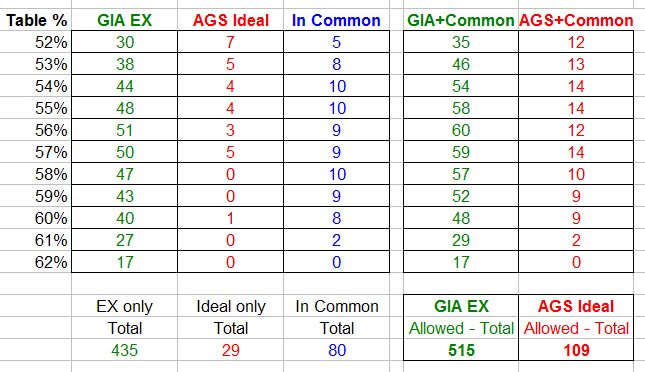
Appreciate it Strm. I corrected the graphics and data. Thanks to Leonid for reposting them. AGS has an 11 level system. GIA has 5 levels. Using the above EX/Ideal comparison charts I pulled some graphics for the top grades only. Across the 10 charts are a total of 544 proportions combinations allowed in EX and/or Ideal. Combos span CA 31.5-37 in .5 increments / PA 40.2-41.8 in .2 increments / T 52-62 in 1% increments. Of the 544 combinations: GIA EX only = 435 In Common = 80 AGS Ideal only = 29 (Pie Chart) GIA EX total: only+common = 515 AGS Ideal total: only+common = 109 (Bar Graph)
|
|
|
|
|
Hadn''t noticed your post before, but I think you should RE-THINK your analysis about it being no surprise, or go back to school nd learn some arithmatic. This is unless of course that you realize how overly wide the GIA paradigm is, DISPROPORTIONATELY, and that GIA EX''s will include AGS 0,1''s,2''s,3''s and 4''s and given the polish issue the spread may be even wider. (I agree with GIA on VG and EX polish still in the top grade, but I disagree with the SEVERE opening up of the EX top grade) |
|
|
|
|
Garry Holloway FGAA DipDT
HCA and Ideal-scope developer http://www.ideal-scope.com and http://www.HollowayDiamonds.com.au |
|
|
|
|
Try again - from Peter Yantzer - in GIA's format (why did they do that?)
A comparison of the 57% table size charts shows that GIA Excellent proportions (outlined roughly in black) had only 26 good and 31 bad matches between AGS0 and AGS1. Included in these bad matches were several very bad matches: 7 AGS 5 & 4 AGS 6’s that would be graded Excellent by GIA. This is a poor match and confusing for both consumers and the industry. The situation is worse for table sizes below 52% where GIA has no Excellent proportion sets. For example at the 51% table size AGS has 17 AGS0 and 22 AGS1 ‘candidate’ proportion sets that GIA would grade as Very Good, Good or Fair.
Garry Holloway FGAA DipDT
HCA and Ideal-scope developer http://www.ideal-scope.com and http://www.HollowayDiamonds.com.au |
|
|
|
|
Still, if though not too helpful for the larger population not schooled on HCA, if you consider the radical change with GIA is for them to have included their crown & pavilion angles, even though it is rounded data, you can still apply this info at will, use the data they now provide, and come away with an educated guess about how favorable your option will be...
Certainly, per HCA protocol, a better initial sort than GIA excellent would otherwise give you. |