|
|
|
|
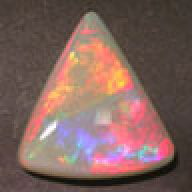
Judging from your posted images (which is not the same as using the actual stone) I''d grade it as an N5 or N6 Multicolor Dark Opal. Someone grading the actual stone might disagree. The term "semiblack" is no longer officially used according to grading nomenclature developed by Australia''s opal industry and the Lightning Ridge Miner''s Association. N1 through N4 stones are called Black Opal; N5 and N6 Dark Opal; and N7 through N9 Light Opal. Many other factors go into judging a precious opal''s value. Ultimately the pleasure an owner derives from a stone and the price paid must balanced against other stones/prices to determine "real" value. You could pay as much or more per carat for an N5 stone than for an N4 depending on colors displayed, brightness, size, etc. The fact your stone displays strong reds (the most valuable color), along with more than two other colors (orange, green and blue) enhances value greatly in my opinion. The intensity or "brightness" of the colors displayed, the stone''s size, its clarity, the thickness of the color layer are also important. I think you bought a very nice stone. It''s most likely cut from a Lighning Ridge "nobby." All opal fields occasionally produce stones with black base colors but this one seems typical of L.R. One other point: the potch color of an opal''s back does NOT determine the body tone. It''s the face-up tone that matters in grading and sometimes opals with light potch backs can "face" much darker. (Definition: "potch" is opal with no play of color.) Richard M. |
|
|
|
|
From the photos, I would agree with the N5-N6 designation, which would have been termed "semi-black" before the current grading scale.
In addition to the darkness of their base body color, the term "black opal" for a long time was reserved for an opal with a dark opaque background. Then the term loosened up a bit to include dark background stones with just a slight bit of translucency. Not much, just a slight bit. If you hold this stone up to a light source and it is "semi-translucent", with a transulency fairly easily noticed, it would further fall into the realm of "semi-black" versus "black" using the traditional (versus modern) terminology. To answer your question "Can a semi-black opal be described as a black opal?", the answer would be, no, not properly so. Although it is common to see the term "black opal" stretched many a time by vendors to include "semi black" (traditional terminology) or "dark, N5-N6" (modern terminology) opals. The gray backed opals with a dark gray body color are most commonly from Mintabie, although as Richard points out Lightning Ridge stones can also have this appearance. In my experience the Lightning Ridge stones tend to have a brighter play-of-color, while the Mintabie stones have a little more subdued appearance due to a slight bit of gray "mask". It's tough to judge from photos, but my initial impression is that it's Mintabie. If the dealer has a "trail back to the source", however, his designation of Lightning Ridge would be more credible than my photo impressions. The "black opal" designation though would tend to make me a little skeptical of other designations. All that aside, though, it's a beautiful stone. I love the red. Do you mind if I ask the carat weight, and how much it cost? |
|
|
|
|
Thank you Richard M! I agree that this opal looks like a N5 or N6. It face up a lot lighter than my N4 opal (see picture below). It also look a bit translucent. For the stone itself, I''m quite happy with the quality. The red is showing very well. I''m just a little disappointed about the body tone.
|
|
|
|
|
Thank you for your answer! I just don''t know how commonly people describe a N5-N6 opal as black opal which I expect to be N1-N4. Maybe I should ask the seller to grade the opal with the N1-N9 scale next time I purchase an opal. This opal is 1.05 carat which measures 6.6 x 6.3 x 4.1. I won it from an aution for $172. Is it a good deal? |