| Re: Ruby Treatment |
|
|
|
Then there is glass filled rubies which is not to be confused with flux healed rubies.
http://lgdl.gia.edu/pdfs/gemsandgemology/articles/Sp06-G&G-article-on-lead-glass%E2%80%93filled-rubies.pdf The first step involves preforming the material to remove any matrix or obvious impurities. The second step is referred to as “warming,” that is, heating the stone to moderate temperatures (reportedly 900–1,400°C). Often used as a first step in standard heat treatment, ”warming” removes potential impurities from the fractures and may improve the color. The third step involves mixing the stone with powders that are composed primarily of lead and silica but may also contain sodium, calcium, potassium, and metal oxides such as copper or bismuth. This mixture is then heated again, reportedly to approximately 900°C, fusing the powders into a glass that penetrates the fractures in the stone. Lead glass filling can be done on both flux healed rubies and those that have not been healed (exposed to the extremely high temperatures required to heal the fissures closed). Lead glass / composite ruby http://www.aglgemlab.com/news/Composite%20Ruby.pdf These types of treatments allows different levels of ruby material to enter the market to fit their respective niche. High-temperature heat treatment and healing of fractures brought Mong Hsu ruby to the market years ago for what was at the time a very low price. Clarity enhancement with high-lead-content glass has brought ruby and pink sapphire to the market for even lower prices. Depending on the original material, some are very fine in quality (face up). Last edited by Chrono on May 11th, 2012, 9:25 am, edited 1 time in total.
|
| Re: Ruby Treatment |
|
|
|
There is a relatively new ruby treatment developed in Thailand that is a modification of the lead glass or composite ruby treatment. The ruby is treated using various chemicals or fluxing agents similar to the more traditional heating of ruby that results in fissure healing and heating residues. During AGL’s investigations, it became evident that in some samples fissure healing was taking place, whereas in others there was less healing taking place but open fissures were still being in-filled with a glasslike material however no lead or bismuth was detected as would be expected of a typical Composite Ruby. AGL has determined it will classify this treatment as glass-filled and not composite ruby.
http://www.aglgemlab.com/news/New%20Ruby%20Treatment-Frequently%20asked%20questions-May%202010-AGL.pdf Traditional heating of rubies As part of the heating process for rubies, it is common practice to coat the stones in a variety of fluxing agents. As the temperature increases, these fluxing agents melt, partially dissolve the ruby’s surface and facilitate in the healing of fissures, effectively sealing and reducing the appearance of the fissures and improving the general durability of the stone. The use of fluxing agents during the heating process results in a combination of features or materials being deposited and remaining along the newly healed fissures. The previously open fissures are replaced by planes consisting of re-grown ruby (synthetic), solidified vitreous melt (glass) and voids (empty bubbles). The relative amount of these three parts depends on many factors. |
| Re: Ruby Treatment |
|
|
|
I think Arkteia asked about fluorescence in rubies so I thought she might like to read this:
http://www.ruby-sapphire.com/heat_seeker_uv_fluorescence.htm Doing this test requires a good bit of gemological knowledge though and just because a ruby might be inert, that does not mean it is unheated. The stone also has to be clean before testing because soap and other chemicals can produce chalky fluorescence. This test is not definitive and should be ONE of the testing methods used together with a complete gemological examination in a fully equipped lab. |
| Re: Ruby Treatment |
|
|
|
You saved me some effort by starting this thread. You had recommended starting a thread about ruby treatment on another unrelated thread, where I had inquired about this stuff, but I hadnt gotten to it yet, so here it is^^
|
| Re: Ruby Treatment |
|
|
|
Ladies and Gents,
I have submitted a request to the moderator to re-title the thread as "Corundum (sapphire and ruby) Treatment" since we bring up the topic of treatments whenever a poster asks about how to select the right sapphire for himself/herself. This way, we can refer anybody to this thread if they have questions about diffusion, high temperature heating, irradiation, and etc with regards to sapphires. Please feel free to add your comments and links. Thanks! |
| Corundum (sapphire and ruby) Treatment |
|
|
|
Sapphires or corundum undergo various treatments ranging from heat only (sometimes this is referred to as low heat although the temperature isn't low at all), diffusion (heated to almost melting point and minerals are added to alter the original colour), clarity enhancement and irradiation.
Diffusion Although this article was written in 2003, it still provides useful information about diffusion. http://lgdl.gia.edu/pdfs/su03a1.pdf Beryllium diffusion is done to improve all colours of corundum, turning almost colourless or pale corundum into stunning yellow and orange sapphires, pink sapphire into a “padparadscha” appearance or a vivid orange, as well as the conversion of bluish rubies to a fine red color. It also can reduce the amount of blue in dark blue sapphires, rendering them a more attractive colour. Not all sapphires treated with beryllium show an intense colour though, so a bright vivid coloured sapphire isn't the only suspect for diffusion. There are many types of diffusion, begining with titanium where it produced a blue layer under the surface, called “surface diffusion” by some gemologists. If you cut into the stone, you can see this effect easily, where it shows the effect of the colour only on the outer rim. With Be diffusion, the induced colour layer penetrates deep into the stone, giving it a full and even colouration. Beryllium is introduced into corundum by adding chrysoberyl to the crucibles in which the stones are heated. As you can see in the many pictures in the article, sapphires from different locales in the world have been subjected to diffusion, not just Songea sapphires. Be diffused stones can be identified by mass spectroscopy like SIMS analysis, LIBS and LA-ICP-MS but these technique is expensive and time consuming. Usually, the presence of certain inclusions is sufficient to prove a particular stone has not been exposed to the high heat temperatures required for diffusions and therefore could not be diffused. 1. CO2 Inclusions – Internal “voids” that contain water and a bubble of carbon dioxide (CO2) are quite common in sapphires from some localities, particularly Sri Lanka. Because CO2 expands when heated, these inclusions cannot survive the very high temperatures necessary for Be diffusion. Therefore, the presence of undamaged inclusions would prove that a stone has not been Be-diffusion treated. 2. Internal voids filled with other liquids will also not survive high-temperature heat treatment. The presence of undamaged liquid-filled voids of any kind proves that no Be treatment has occurred. 3. Included Crystals – The presence of undamaged zircon crystals in a sapphire is a good indication that Be diffusion treatment has not taken place. It is unlikely that any crystalline inclusion could survive the temperatures required for Be diffusion without being significantly altered. Therefore, the presence of transparent, angular, or rounded solid grains of any mineral would be an excellent indication that Be diffusion has not taken place. 4. Rutile Needles – Needle-like inclusions of rutile, often referred to as “silk,” are common in corundum from many localities. These needles usually survive the lower-temperature heat treatments that are performed on some sapphires. However, they typically do not survive the higher-temperature treatments to which most blue sapphires and rubies are subjected, including the very high temperatures necessary for Be-diffusion treatment. The presence of unaltered rutile needles means that a stone has not been exposed to this (or any other) high-temperature treatment. Diffused corundum is not affect by routine cleaning (steam and ultrasonic) and jewellery repair procedures. The treatment is stable and permanent. However, it is well known that the use of borax-containing chemicals (both fire coat and flux) contributes to moderate to severe surface etching of corundum. If etching due to exposure to borax-containing compounds is severe enough, the stone might have to be repolished. Transparent corundum is actually a common commodity. Only corundum in attractive colors and color saturation levels is rare. There are large deposits of sapphire that can produce large stones in unmarketable colors. Conventional heat treatment can improve only a very small percentage of such material. However, it appears that much, if not most, of this material can be Be diffused to produce attractive colours. |
| Re: Ruby Treatment |
|
|
|
Irradiation
Some corundum (pale yellow, brownish and grayish sapphires) are sometimes irradiated to produce an attractive saturated golden yellow to orange yellow colouration. This type of treated sapphire is safe for wearing but the colour will fade over time. Irradiation is difficult to detect through lab testing and a "fade test" will take some time. |
| Re: Ruby Treatment |
|
|
|
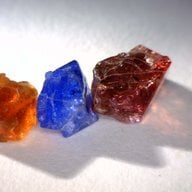
A bit of an eye opener on how effective diffusion is at improving the appearance of sapphires. Note that not all diffused sapphires start out looking like the gravel posted below.
http://www.palagems.com/gods_graves_sapphires.htm
|
| Re: Ruby Treatment |
|
|
|
Really interesting (at least to me) chart showing how the labs define the levels of flux healing with pictures shown on Page 2.
http://www.lmhc-gemology.org/pdfs/IS1_18012010.pdf |
| Re: Ruby Treatment |
|
|
|
Heating: What does it do and why
A majority of sapphires and rubies are heated to change colours, intensity the saturation and also increase clarity. Those that come out of the ground looking great (done by Mother Nature herself) are less common and thus command higher pricing. Heating improves clarity by "removing" the opaque inclusions and also allowing chromophore-type elements, such as Ti (titanium) and Fe (iron) to become part of the corundum crystal and help colour the stone. Heating is essentially the oxidation of corundum impurites which are composed of rutile (TiO2), spinel (ideally MgAl2O4, but often "impure") and iron titanium oxides such as ilmenite (FeTiO3). Corundum's melting point (~2000 °C) is higher than most of its common inclusions. Thus, heating allows the solid inclusions to resorb or "melt" back into the corundum's crystal structure without melting the corundum. The reduction of Fe3+ to Fe2+ causes colour in a variety of sapphires to change. Stones that are too deeply blue may be lightened by the oxidation of Fe2+ to Fe3+. In some cases, heat treatment will improve the depth of color because heat causes dissolution of inclusions and diffusion of impurites (especially Ti from rutile inclusions) into the surrounding corundum. Because fine inclusions cause some stones to look cloudy, heat treatment that dissolves the inclusions may also improve the clarity of the stone. Fluid inclusions and fracture-type inclusions won't add to a stone during heat treatment, but these features can be annealed or healed to make them "disappear". Consequently, the clarity of the treated stone can increase dramatically. |
| Re: Ruby Treatment |
|
|
|
Is there more than berillyium treatment going on with these? They look opaque to me? I thought it was a coloring agent not a clarity enhancer. |
| Re: Ruby Treatment |
|
|
|
Innerkitten,
As you can see, not all the "gravel" were improved - some remained dark and blackish. Some that are overly dark are lightened in tone with heating, then diffused to alter the colour. Heating also improves the clarity by dissolving the inclusions. Fluid and fracture type inclusions will be "healed" and disappear as they melt back into the surrounding corundum. |
| Re: Ruby Treatment |
|
|
|
Bravo and Thank you Chrono for sharing such enlightening information with the group. It is sound material of which i had some but not all of it.All this should be in any gem collectors archives for future reference material. Thank you once again for the diligent work in rounding up all this wonderful information. Most Respectfully; Dana Reynolds ASG Certified Supreme Master Gem Cutter #96cge42 |
| Re: Corundum (sapphire and ruby) treatment |
|
|
|
Oiling
An increasing number of sapphires treated with oil are appearing in the marketplace. Oiling the stone is a way to fill surface fractures. This treatment enables gem dealers to sell a larger stone (at a higher price) because fractures that might otherwise have to be cut away are filled with oil. Oil fillers are not stable and will evaporate over time, leaving a less attractive stone with readily apparent fractures. This treatment is coming into use and is often not disclosed by the gem supplier. http://jcrs.com/JCRS_for_consumers/jewelry_information/colored_gems/sapphire.htm |
| Re: Corundum (sapphire and ruby) treatment |
|
|
|
There are many pictures on Page 6 (figures 1 through 9) showing that some clarity enhanced rubies do not need to undergo high heat temperature heating. Silk in the form of fine intersecting needles both in isolated clusters and as part of hexagonal zones are often present, as well as crystals and negative crystals. None of these inclusions reveal any indications that they had been subject to heating, at least above 1300C. This "low heat" step is important to remove the impurities possibly present in the fissures that could create some problems when the glass is added. The heat treatment may also by itself improve the stone color. This “warming” can be conducted at different temperatures from 900C to 1400C depending on the ruby type. As 900C is not hot enough to melt some inclusions as rutile, many stones can still have an “unheated” aspect. But all stones are heated.
Thank goodness the glass can be detected by some tell tale bubbles and coloured flash though! http://www.giathai.net/pdf/Ruby-Glass_Composites.pdf |
| Re: Corundum (sapphire and ruby) treatment |
|
|
|
Thank you, Chrono, very helpful and interesting. What scares me is that even best labs can make mistakes.
|
| Re: Corundum (sapphire and ruby) treatment |
|
|
|
I simply want to move this thread to the top of the page, in case someone has not read it, it contains wealth of information! I think it should be pinned, all educative threads are so important, not only for the new members, but for old ones, too...
|
| Re: Corundum (sapphire and ruby) treatment |
|
|
|
Excellent work Chrono.
That combination of flux healed and glass filled is one to watch for now. I had not seen one, or at least I thought I hadn't. Just now I was ready to call a ruby I was looking at as a flux healed when I saw a tiny bubble. On closer exam it turned out to certainly have flux veils PLUS bubbles in glass. Previously when I saw flux veils and natural inclusions I thought I was done looking! Best regards, Lee |
| Re: Corundum (sapphire and ruby) treatment |
|
|
|
I hope I'm not stepping on your toes, Chrono, just wondering if you saw this article about Winza rubies and heat treatment in the field, from the GRS.
http://www.gemresearch.ch/news/Tanzania/Tanzania.htm It's not as informative as your articles, and hopefully I didn't duplicate one of your articles. |
| Re: Corundum (sapphire and ruby) treatment |
|
|
|
This is old news but I wanted to point out that just because the sapphire isn't neon in colour means it has not been diffused. The link below shows many pretty blue sapphires that have been diffused.
http://www.gia.edu/research-resources/news-from-research/Be-diffused_blue_sapphire.pdf Lots of amazing research done on treatments for all types of gemstones! http://www.gia.edu/research-resources/news-from-research/index.html |
| Re: Corundum (sapphire and ruby) treatment |
|
|
|
Update for new diffusion treatment of corundum. Do NOT assume that if your sapphire shows zoning, it is not diffused. That is no longer true with this new diffusion method.
http://www.gemresearch.ch/news/2011-12-19_Alert/Alert.htm Snippet: A large number of diffusion-treated stones are detected in the laboratory. The diffusion-treatment includes the well-known method of adding Titanium in the surface. Some of the material has been additionally Beryllium-treated. The new aspect of this treatment is that the treaters obviously select already heat-treated sapphire with internal blue color-zoning. Than the stones are diffusion-treated and recut. This allows the stone to be enhanced by 1-2 color grades. When such stones are recut by the end consumer, the color becomes lighter mostly back to the color grade previously to the diffusion-treatment. GRS uses immersion and ED-XRF chemical testing and LIBS-testing to identify the new method. More details will follow later. Buyer be aware of using color-zoning in any heat-treated sapphire as a criteria to distinguish between diffusion-treated and non-diffusion-treated sapphires. Such stones may well be diffusion-treated. Furthermore, the blue edge effect may have been made less obvious by an additional Beryllium-treatment process. This would make the identification with the loupe even more difficult. |
| Re: Corundum (sapphire and ruby) treatment |
|
|
|
Edited for clarity. |
| Re: Corundum (sapphire and ruby) treatment |
|
|
|
I've tried searching, unsuccessfully, for a list of labs that do gemstone evaluations; labs from different countries, those that identify treatments and those who identify origin. I finally found an old thread and thought I would attach it here. Hope others find it relevant too.
http://www.pricescope.com/forum/colored-stones/best-worst-gemstone-certifying-labs-t165081.html |