|
|
|
|
I am a viewer and I have no idea. I thought it was a preference (just like I prefer vintage round cuts to H&A cuts). I do like it a lot in radiant shapes, but dislike it immensely in others like marquise & pear. It's particularly bad when I see it is mixed with chunkier facets in something like a cushion. Though in general too crushed to me always looks bad no matter what. I know I have been told that in most cuts it is a sign of a bad cut. I haven't seen a radiant in person that doen't look "crushed" to me. But my thoughts on crushed ice might be different than others. I'm interested to know what professionals think. |
|
|
|
|
Heh Kenny seems like a loaded question. I've never heard of it being anything other than a negative term. We don't want to wear watery crushed ice on our hands otherwise we could save major $$$ and buy polished glass or cubics. Please provide a post or pictures of where it is used as a positive descriptor. My impression is mostly from how Rhino uses the term, to describe less than optimal light return in Fancy shape diamonds, given you have a lot of experience please reference where you have seen it used in other ways. |
|
|
|
|
I do not have a photographic or perfect memory or the time to do searches of 5 years of posts. It is just an impression I am left with after reading here for 5 years. I do not consider the term crushed ice to be a negative thing. (maybe I need more training) I see the look in almost all cuts off axis, even great cuts like my ACA, Solasfera, Asscher and Octavia. I'd say it is most noticeable in radiants, and some cushions, pears and ovals, even on-axis. It is the look of many many small facets or virtual facets of no particular shape in no particular pattern or a relatively indistinct pattern. I do not consider it a negative, and actually it is a quite accurate descriptor for a look most diamonds have off axis. I think the only diamonds which did not have some of this look would be 30+ carat step cuts. I seem to recall me using the term years ago and Rhino reacted strongly. I did not intended to ask a "loaded question" and am not starting some flamewar, but apparently this term pushes a button in some people so I'm looking into it. It is just a word, but if it always has a negative connotation I will avoid the use of the word when describing diamonds. |
|
|
|
|
Searching for a rectangular cushion that wasn''t a heavy crushed ice look was hard. I wanted crisp, fine facets. Didn''t exactly get the look I wanted.
Perhaps it doesn''t exist. One problem with radiants I found over and over was that "coke bottle circle" that seemed to be in so many so called great cut stones. |
|
|
|
|
This is actually quite interesting.
When I got the smaller Octavia, after being accustomed to an larger asscher with an extremely prominent and strong pattern, and those large bars on all four sides, I kind of missed seeing a strong pattern in the Octavia. That's why I'd love a 3-carat Octavia. I like seeing a pleasing prominent pattern in my diamond. Yes the look of colors of random shape and distribution is beautiful too but my personal preference is for a pleasing strong pattern. Maybe because I'm a rigid, control-freak, perfectionist, order-embracing kind of person. |
|
|
|
|
I like distinguishable order in particular. Even princesses are just too busy and chaotic for me, and they can certainly be very symmetrically patterned.
My favourite shapes are rounds and asschers actually - totally opposite personalities (and I want one of each!) but both exhibit observable (IRL, without the aid of additional gadgets and gizmos) radial symmetry. |
|
|
|
|
My preference is to steer clear of busy stones. I like asschers, old cuts, emeralds, etc for this reason. I even find round brilliant stones are too busy for my taste so a crushed ice stone is not my cup of tea at all.
When I was looking (hopelessly) for a cushion locally I only ever saw one that wasn''t the crushed ice type so they seem to be very common. I suppose there are people who are happy with them since they continue to be cut and sold. |
|
|
|
|
|
|
|
|
|
I'm going to get into big trouble here.
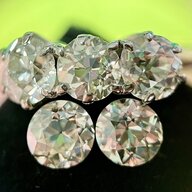
If many people define crushed ice look as a negative, and I don't, and I used it to describe not only Octavia but every finely-cut diamond I own I'm going to wake up dead tomorrow. This is a horrid pic that is the only one I have already taken which remotely is useful here. See how in the asscher the pattern is prominent? See how in the Octavia (the top stone) the pattern is not as prominent as in the asscher? The Octavia is a little off-axis. When even more off-axis the pattern is even more vague as in all diamonds. What you see in the Octavia is a very very bright diamond (the goal of this pic, though poorly executed ) but not the strong pattern? To me seeing a lack of pattern IS the crushed ice look. I suspect 99.9% of diamond industry experts will call my definition of the crushed ice look wrong. Associating crushed ice with Octavia will be like sullying the reputation of a 15-year old Spanish virgin who lives out in a small rural village. Do not make that association. Rather, blame me for not adopting the apparent industry standard of the definition of the crushed ice look.
|
|
|
|
|
hahhahah!! Ok, I think you are using the term wrong. What you are describing sounds like you like high contrast patterns in yoru diamond, not small contrast patterns. |
|
|
|
|
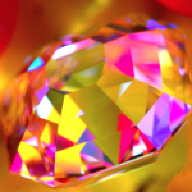
In my opinion small flash or small virtual facets is not the problem if the stone was full of them! Thats why some people like the 102 faceted rounds and many modern cuts. But that is not what I would use the term watery crushed ice to describe as and I don''t see it used to describe rounds very often. But the example below has a lot of leakage combined with small flash giving the "watery crushed ice" it looks a bit like slush, and this is where I feel the term is most accurately used.
|
|
|
|
|
Well I don't associate brightness with crushed ice no sir. A stone with nice bright flash uniformly distributed is not what I see when I look at crushed ice. Your octavia looks much brighter than your other asscher and is full of life the exact opposite of crushed ice to me. I do think some people associate small flash with an overall brighter stone and it can often be the case, its why a lot of modern cuts perform so well in halogen office lighting and are cut this way but once again I wouldn't use the term crushed ice to describe these stones. There is no industry standard, this isn't a technial term, its a descriptive term, but I gotta ask you when you look at crushed ice or a slushy ice does it remind you of your octavia? When you look at a glass of water with crushed ice in it does it remind you of your bright octavia or a dead looking cushion?Oh and I'd be happy to take your "Crushed Ice" Diamond off your hands anytime it becomes a burden to you . I'm sure my wife of 1 week would be happy to wear it as a RHR. |
|
|
|
|
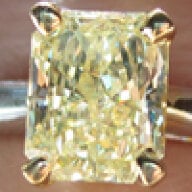
I think crushed ice diamonds are pretty too - they have a very glittery sort of look that is different and sparkly in a close up sort of way. Most of the diamonds I''ve seen with this look have been yellow radiants. My diamond has a bit going on in the ends and I always thought it was pretty and I loved that my diamond "did it all" and I enjoyed all worlds of fire :)
|
|
|
|
|
Hi Kenny,
I read this thread with interest. Let me first try to give my definition of ''crushed ice'': a preponderance of small virtual facets, with almost no bigger virtual facets. This is most often caused by too many facets and/or asymmetry. Depending on the shape and faceting-pattern of the diamond, it can occur more or less frequently, in other words, some shapes and faceting-patterns lend themselves easier to a crushed-ice-look. I personally would not use the term for a stone, being observed from an angle, since that stone will probably still show bigger virtual facets, and if in movement, the nature of the stone will continually change. A stone with ''crushed ice'' observed face-up will likely not have bigger-size virtual facets when tilting the stone. From experience with consumers, my feeling is that the general preference of unprepared consumers in real-life-observations is not for a crushed-ice-look. So, I definitely consider it as a negative term. For that reason, I suppose that many producers of multi-facet-stones often use huge models of their stones to show them off compared to a regular round-brilliant. Because of the size of these models, they probably indeed look better. On a side-note, that is also one of the pitfalls of online-observations. Pictures are a lot bigger than the actual stones, and the observation is not the same as in-real-life. As a reference, look at the current Cushion-poll of Garry. He indicates a preference for stones with more virtual facets. I wonder if this is not due to the size of the pictures. Live long, |
|
|
|
|
Actually Paul there was a poll we ran recently with 9 different cuts and the stone in the upper right here http://www.octonus.com/oct/projects/foxymovies/MSS_9_diamonds_Daylight.phtml has a strong crushed ice appearance. In general it was not so popular. But this type of cut works well with fancy coloured diamonds because it has a linger ray path average length as light tends to bounce around a lot before it leaks out. Hence they do not appear as bright. Typically 70-80% of the light return of a well cut round. Paul none of the 9 cushion stones in the currently pinned at top has a crushed ice effect - small virtual facets plus longer ray paths are the trick - most of those stones have light return as good or better than most rounds.
Garry Holloway FGAA DipDT
HCA and Ideal-scope developer http://www.ideal-scope.com and http://www.HollowayDiamonds.com.au |
|
|
|
|
I''m not a fan of the crushed ice look, personally, but i think it might be subjective. Llike some people like flour and some are obsessed with "arrows". I''m not a fan of either of those, but that doesn''t make them "bad" in general, just bad for me.. especially when it comes to upgrading and everyone is OBSESSED with the "perfect H&A cut"
|
|
|
|
|
"Polished glass or cubics" I remember years ago when a friend of mine asked if the Rolex I was wearing was real. I said, of course, why do you ask? He commented that you could wear a copy/replica and no one would know the difference. I then told him the most important person would know the difference...........ME. So no polished glass or cubics..........
|
|
|
|
|
I agree about the effect looking better in colored diamonds, it is a personal preference however.
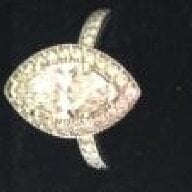
One of the prettiest PS rings I''ve seen is a pinkish champagne ''crushed'' radiant...the person doesn''t post here anymore, but here is a link for reference. http://www.pricescope.com/idealbb/files/gsring307.jpg |
|
|
|
|
Hmmm, I''m trying to decide if I should be insulted or not with this thread, lol. I do understand where most of you are coming from as I didn''t ever like the "crushed ice" look before I found my stone. But I have to say once I looked into this stone it was like looking into space with never ending stars. I think it''s a matter of preference and I think the look has it''s place. Hmmmm maybe I should go back to my jeweler and tell him that he sold me an undesireable stone and I want a partial refund. I think he''d knock me upside the head for sure, lol.
|
|
|
|
|
I don''t think you should be insulted. The better the light return in your yellow fancy diamond the lighter the yellow color would be. You paid a premium to have that deep yellow color and that is why the cutter chose a radiant for that piece of rough. Radiants are much more common in colored stones as the light return is not as good in this cut allowing a long ray path and more absorption thus enhancing the intensity of the color. Worse light return = better color retention. But again I wouldn''t call your stone crushed ice because I see an intense yellow color, and I haven''t seen any crushed ice that looks like this unless well a dog really reallly had to go to the bathroom on that patch of ice and he/she had been holding it in for many days so the urine was that saturated . |